Neuroarchetypes
The same outside world.
A different inner setting. A different experience.
A Neuroarchetype is the default map of your autonomic nervous system: how your body processes load, assesses safety and manages its energy.
The nervous system in your body decides before you do.
Before reason gets involved, the body has long been assessing whether there is safety, pressure or overload.
stays in inner tension even in the middle of a calm life.
feels almost nothing.
functions brilliantly on the outside but runs on reserve inside.
The default map of your nervous system
The Neuroarchetype is my own default map of the ways the autonomic nervous system (ANS) can organise itself and respond to load, safety and environment.
It represents the basic setting of the human hardware – the underlying structure by which your body, from birth, processes load, assesses safety, distributes energy and triggers defensive or creative mechanisms.
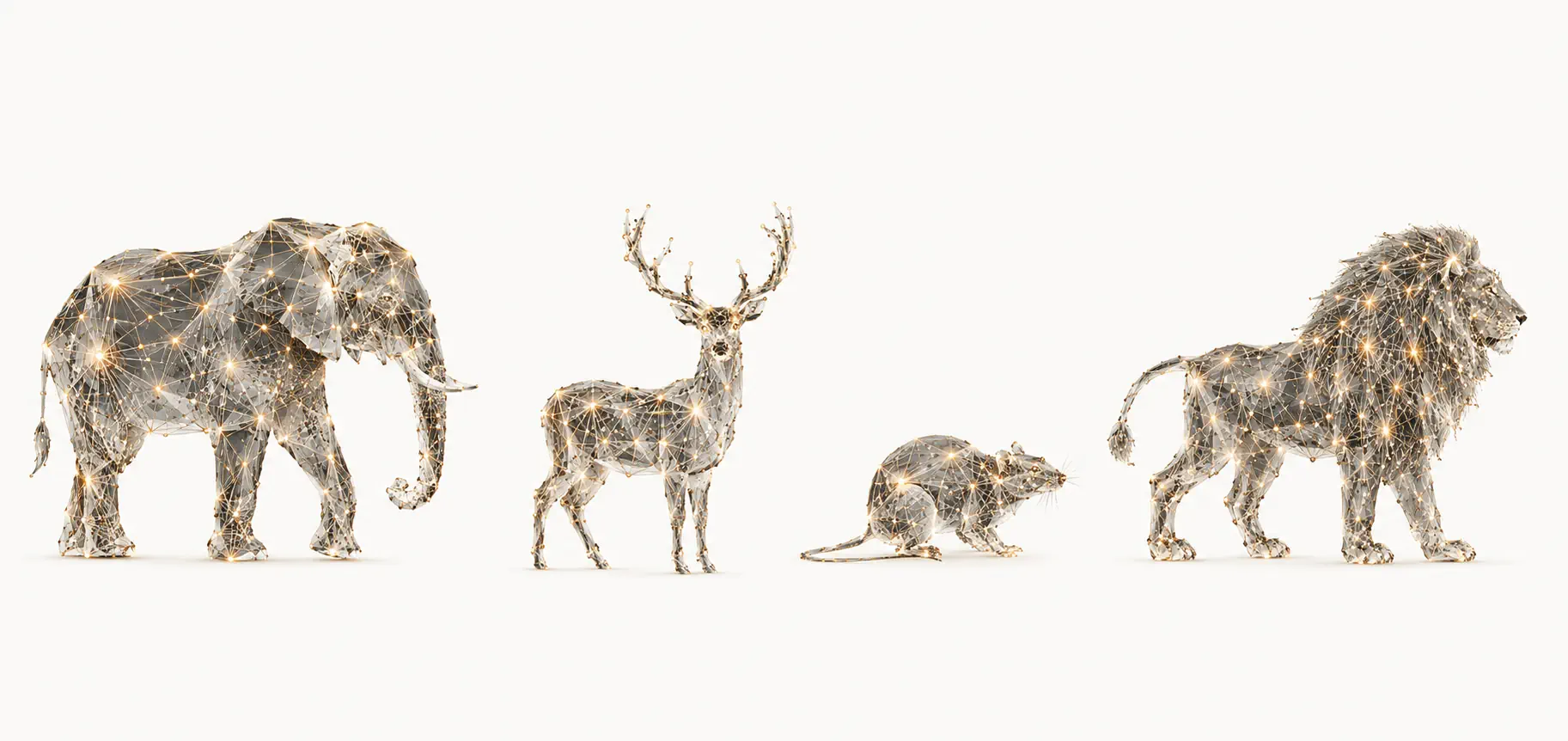
Why animals? Naming through animal archetypes has nothing to do with symbolism or personality typology. Animal archetypes offer a clear image of different mammalian strategies of adaptation and survival. The brain loves shortcuts and visual metaphors: an animal archetype shows instantly, without complicated theory, how your body behaves under threat.
What a Neuroarchetype is not
- A psychological test or a personality questionnaire
- Questionnaires capture mainly how a person perceives and describes themselves at a given time. Their result can therefore be influenced by the current state, learned strategies or the way a person interprets themselves.
- A diagnosis or a label
- It does not judge your intelligence, character or abilities. It doesn't say what kind of person you “are”.
What a Neuroarchetype is
- A map of the biological basis
- It describes the characteristic tendencies of your nervous system — how it reacts to stimuli, load and environment, and how it works with the capacity available to it.
- A manual for managing capacity
- It shows what your system handles well, what burdens it, where it starts to lose capacity and what strategies it uses under pressure. It helps you tell when you are functioning from your natural capacity and when you are already relying on compensation strategies.
Every system has a different capacity
Hypersensitive type
Biological basis: A low threshold of irritability and high sensitivity. Gets flooded by excessive stimuli and overloaded very quickly.
High-capacity type
Biological basis: Strong vagal tone and a wide window of tolerance. Reacts more slowly, is stable.
Reactive type
Biological basis: Works in short, intense waves followed by a need for deep rest.
Two completely different ANS systems
While the Lion works through dominance, expansion and direct action, the Mouse operates differently.
The Lion system is “high-performance”: it is set up for leading, deciding, visibility and protecting its own territory.
Under pressure, however, its strength can turn into a defence mechanism.
It is an underground strategist. It observes, collects data, calculates risks and picks up what escapes others.
Under stress, however, its superpower can turn into a trap.
An attack on competence, a disrupted plan, disrespect or an unexpected loss triggers rapid mobilisation.
The Lion doesn't back down. It speeds up, increases pressure and tries to regain control.
The Mouse doesn't automatically go into direct attack. Its system tries to survive through analysis, control of information and withdrawal.
In business this can show up as criticism, directiveness, a need to convince others or to react immediately.
What looks like strength from the outside may actually be a defensive reaction of the system.
- Hypervigilance and overthinking. The brain scans risks, creates scenarios and tries to solve the problem with the head.
- Withdrawal into solitude. Instead of conflict comes closing off, limited communication and a need for a private safe space.
- Limiting further input. When capacity is full, the system starts refusing more information, stimuli or intake.
Clear personal space, boundaries and room for a big vision.
- Bounded working hours. If work never ends, the system stays on alert.
- Delegation. The Lion is meant to lead and set direction, not to be a labourer on its own building site.
- A physical outlet. More intense movement, strength and challenge help use up accumulated mobilisation energy.
- Retreat into privacy. Time without an audience, demands, communication and decisions.
- Strategic recalibration. Regularly step out of operations: Where am I heading? What drains my energy? What should I cancel?
- Protecting information capacity. Fewer messages, e-mails, social media and constant input.
- Structured order. A clean space, clear information and a clear plan reduce the number of things the system has to keep scanning.
- Returning from the head to the body. Rhythmic walking, gentle proprioception and calm movement without performance pressure.
- Working with detail. Fine motor work, assembling, repairing, coding: deep focus on a small, controllable world.
- A safe space at home. A place and time where nobody has a claim on the Mouse and where it can be completely offline.
- Microdosing tasks. Break a large whole into small concrete steps. When the next step is clear, overwhelm decreases.
For the Lion, long-term calm doesn't mean doing nothing. It means doing mainly what matters, protecting its space, releasing accumulated energy and regularly returning from operations to the vision.
The Mouse doesn't regulate by adding more intensity. It needs less noise, more order, privacy, predictability and the chance to process the world in smaller doses.
From Warrior to Architect
The Lion system needs to interrupt the impulse to act immediately.
Slow down the input
Don't react to the trigger right away. Change the space, get up from the desk, have a drink, create time between the stimulus and the response.
Work with the exhale
A double inhale through the nose and a long exhale help lower physiological activation.
Return to the body
Straighten up, relax your shoulders, or briefly tense your muscles and then let go.
Withdraw and reduce the input
The Mouse system does not regulate through more intensity. It needs less noise and fewer stimuli.
Withdraw into yourself
Step away for a while into a quiet private space where no one has a claim on you.
Limit incoming information
Close messages, e-mails and social media. With fewer inputs, the system can stop scanning its surroundings.
One small step
From the big whole, choose just one concrete, clear next step. When the step is clear, overwhelm drops.
Knowing your own Neuroarchetype gives you a compass and an emergency brake.
Instead of continuing to damage your business and health in panic and stress, you know exactly:
when your system shut down,
why it did so,
and how to safely switch it backinto the mode of an adult, strategic creator.
The organism's hardware operating system
The autonomic nervous system (ANS) is the part of the nervous system that continuously controls processes you don't have to control consciously – heart activity, breathing, digestion, blood pressure or energy management. At the same time it takes part in how the organism assesses safety, load and threat.
It runs 24/7 in the background. It influences how much capacity you have available at any moment for thinking, decision-making, creativity, relationships and performance.
You can have the best strategy, experience, a great mentor and a brilliant idea. But if your system is exposed to high load over a long period, the way you work with attention, information and decisions changes.
So sometimes the problem is not that you don't know what to do. The problem may be the state your system is deciding from.
Safety & Capacity
What is happening
The organism has room for flexibility, regulation and adaptation.
In business
Broader perception, perspective, creativity, relating, strategic thinking.
Mobilisation & Action
What is happening
The system raises activation and prepares the organism to meet the demand.
In business
Energy, speed, decisiveness and performance. With prolonged activation, pressure, control, narrowed attention or a mode of constant “firefighting”.
Protective shutdown
What is happening
Under high or prolonged load, the organism reduces activity and conserves available resources.
In business
Fatigue, slowing down, overwhelm, brain fog, procrastination, loss of motivation or a sense of disconnection.
These are not three fixed boxes. The ANS works dynamically, and the individual responses can overlap and change with the situation, experience and current capacity.
What happens in high activation and overload
In high activation you may:
- focus your attention mainly on the immediate problem,
- react faster and more impulsively,
- lose the wider context and perspective,
- shift into more control and pressure to perform,
- be less aware of signals of fatigue and the need to regenerate.
With long-term or excessive overload, on the other hand, fatigue, slowing down, overwhelm, difficulty concentrating or a sense of disconnection may appear.
How I determine the Neuroarchetype
What I determine the Neuroarchetype from
To determine the Neuroarchetype I use exact birth data, which in my method serves as the organism's initial chronobiological imprint.
Unlike common questionnaires, which mainly capture how a person perceives themselves and how they currently react to stress, birth data is not influenced by their current mental state, learned strategies or how they happen to interpret themselves right now.
Within the Neuroarchetype model, it therefore makes it possible to determine the default architecture of the system — its basic neuro-energetic tendencies — before life experience, learned strategies and compensation shape how it functions.
What the method is based on
The Neuroarchetype is my own working model, connecting insights from neurobiology, the physiology of the autonomic nervous system, somatic work, the polyvagal perspective and systemic mapping of human capacity.
The animal archetypes here serve neither as spiritual symbols nor as personality types. They are clear images of different biological strategies that help translate the complex functioning of the nervous system into a language people understand quickly.
How Neuroarchetypes came about
I came to Neuroarchetypes during long-term study of systems that work with the exact moment of birth as a starting point for mapping individual differences.
It was working with the date, time and place of birth that led me to ask whether this type of input could also be used in a different way – not to describe personality or character, but to create a map of the individual tendencies of the autonomic nervous system.
Gradually I began to develop this concept, connect it with my work with the nervous system, and created my own model, which I now call Neuroarchetypes.
The date, time and place of birth are input data in the model. The way they are interpreted and the resulting Neuroarchetype map are part of my own model.
Neuroarchetypes are therefore not a diagnostic system. They are my own way of looking at individual differences in how the nervous system is organised and functions.

Kateřina
I have created my own map, Neuroarchetypes, which goes further than the usual division of the nervous system into a few basic patterns, or subjective tests and questionnaires.
More about me ›Which Neuroarchetype carries your performance?
In the Individual Analysis we map your system. You leave with a named pattern, your personal Neuroarchetype map and a clear next step.